M&A due diligence checklist
Every document to request, sorted by team, with the red flag each one catches.
1Financial due diligence checklist
Red flag The auditor changed or resigned, or an opinion is qualified.
Red flag Monthly results jump just before the sale process starts.
Red flag Add-backs have no document behind them, or recur every year.
Red flag Pilots or lost customers are counted in recurring revenue.
Red flag Deferred revenue is left out of the working capital target.
Red flag A lender's lien must be released before the assets can transfer.
Red flag Old receivables have no reserve, or suppliers are paid late to lift cash.
Red flag The bank balance does not match the cash in the accounts.
Red flag The forecast needs growth the business has never achieved.
Red flag Capitalized development hides spending that recurs every year.
Red flag A guarantee or purchase commitment sits outside the accounts.
2Legal due diligence checklist
Red flag The charter gives one class of holders a veto over the sale.
Red flag Minutes stop for long periods or record an undisclosed dispute.
Red flag An entity outside the deal holds a key contract or asset.
Red flag A key customer can refuse the assignment, and its revenue stays behind.
Red flag A lender's lien covers assets the seller says are free and clear.
Red flag A partner holds consent or buyout rights on a sale.
Red flag An open claim has no reserve and falls outside insurance.
Red flag A permit cannot transfer, which delays operation after closing.
3Tax due diligence checklist
Red flag Returns show lower income than the accounts the price rests on.
Red flag Subscriptions are taxable in a state where the target never registered.
Red flag Late payroll deposits carry successor and personal liability.
4HR due diligence checklist
Red flag Pay sits far from market in critical roles.
Red flag Key functions report to the owner with no deputy.
Red flag Payments fall due at closing and are missing from the price.
Red flag Earned bonuses are unpaid and missing from the debt schedule.
Red flag An underfunded or multi-employer plan carries an exit cost.
Red flag Contract developers wrote core code with no IP assignment.
Red flag An agreement requires consultation before the sale can close.
Red flag The same manager or site appears in repeated complaints.
Red flag Key staff do not move automatically and can decline the buyer's offer.
Red flag Key staff have no restriction, or it cannot be enforced where they work.
5Commercial due diligence checklist
Red flag A top customer has a renewal due within the year.
Red flag Customers can cancel at will, so ARR is not committed.
Red flag Discounts are rising while list prices stay flat.
Red flag Most of next year's forecast is unsigned pipeline.
Red flag Credit notes after period end reverse revenue already booked.
Red flag Hosting depends on a single contract that ends on a sale.
Red flag The seller's view leaves out a competitor winning its customers.
6IT due diligence checklist
Red flag A core system is end of life with no funded replacement.
Red flag A breach was never reported to regulators or customers.
Red flag The notice bars transferring the customer list to a buyer.
Red flag A copyleft component is linked into code the target distributes or hosts.
Red flag Backups have not been tested in the last year.
Red flag Staff use AI tools on customer data with no approval or contract.
7Intellectual property due diligence checklist
Red flag IP is pledged to a lender, so it cannot transfer clean.
Red flag Repository history shows a contributor with no signed assignment.
Red flag An affiliate clause would extend a patent license to the buyer's own portfolio.
Red flag A demand letter threatens the product the buyer is paying for.
8Real estate and environmental due diligence checklist
Red flag The landlord can refuse consent or end the lease on a sale.
Red flag Key equipment shown as owned is leased or near end of life.
9Insurance due diligence checklist
Red flag Cover has gaps or lapses, leaving the buyer exposed from day one.
Red flag Claims are rising, and premiums will follow.
10Regulatory due diligence checklist
Red flag A regulator's letter shows a problem ahead of any fine.
Red flag Payments to officials or agents have no approval trail.
Red flag A required filing pushes out closing or forces a remedy.
Red flag A government contract needs approval or novation before it can move.
Red flag Published emissions claims do not match site data.
11Added for an asset purchase
Red flag The seller's unpaid sales tax can follow the assets to the buyer.
Red flag A missed bulk-sale notice leaves the buyer liable for the seller's tax.
Red flag Ending and rehiring staff triggers WARN notice or severance.
Red flag The notice bars transferring the customer list to a buyer.
Red flag An asset the business needs sits in another entity or is left out.
Red flag An assumed liability is wider than described, such as all warranty claims.
Red flag A key customer can refuse the assignment, and its revenue stays behind.
Red flag A permit cannot transfer, which delays operation after closing.
Red flag The business cannot run on day one without services the seller keeps.
Red flag IP is pledged to a lender, so it cannot transfer clean.
12Added for a software company
Red flag Code sits in a personal account the company does not control.
Red flag Repository history shows a contributor with no signed assignment.
Red flag A founder wrote core code before incorporation and never assigned it.
Red flag An offshore contractor's assignment does not work under local law.
Red flag A customer or partner holds a copy of the code or a right to one.
Red flag An affiliate clause would extend a patent license to the buyer's own portfolio.
Red flag A product sits in a founder's company, outside the seller.
Red flag The seller's list misses components a scan later finds.
Red flag The seller refuses a scan of the code.
Red flag A copyleft component is linked into code the target distributes or hosts.
Red flag A customer can claim source code under loose release terms.
Red flag The sale itself is a release event that hands code to customers.
Red flag Pilots, month-to-month deals or lost customers are counted in ARR.
Red flag A hand-built schedule does not reconcile to the billing system.
Red flag ARR cannot be reconciled to recognized revenue.
Red flag Newer cohorts retain worse than older ones, hidden in the average.
Red flag Net retention looks strong while gross churn is high underneath.
Red flag Growth comes from one-off expansion while new customers slow.
Red flag Prepaid contracts carry service costs the working capital target ignores.
Red flag Personal data is held with no documented legal basis.
Red flag An old notice promised never to share data the buyer plans to use.
Red flag A customer's terms bar a new processor or a change of hosting region.
Red flag A breach was notified late or not at all.
Red flag Customer data cannot move without new notice or consent.
Red flag A few accounts hold most ARR and renew soon.
Red flag Side letters give terms the template does not show.
Red flag A top customer can leave on a sale without penalty.
Red flag Most-favored pricing or caps limit pricing after closing.
Red flag Customers holding large ARR must consent before contracts move.
Red flags to look for in due diligence
Customer concentration
A few large customers can take much of the revenue with them.
EBITDA adjustments without support
Each add-back to earnings should trace to a document in the data room.
Change-of-control clauses
Loans, leases and key contracts can end or need consent at closing.
Missing documents
A gap the seller cannot explain often hides the answer the buyer needs.
Open claims and regulator letters
Litigation and regulatory findings carry costs the price may not cover.
Key people likely to leave
Founders and senior staff without a retention plan can walk after closing.
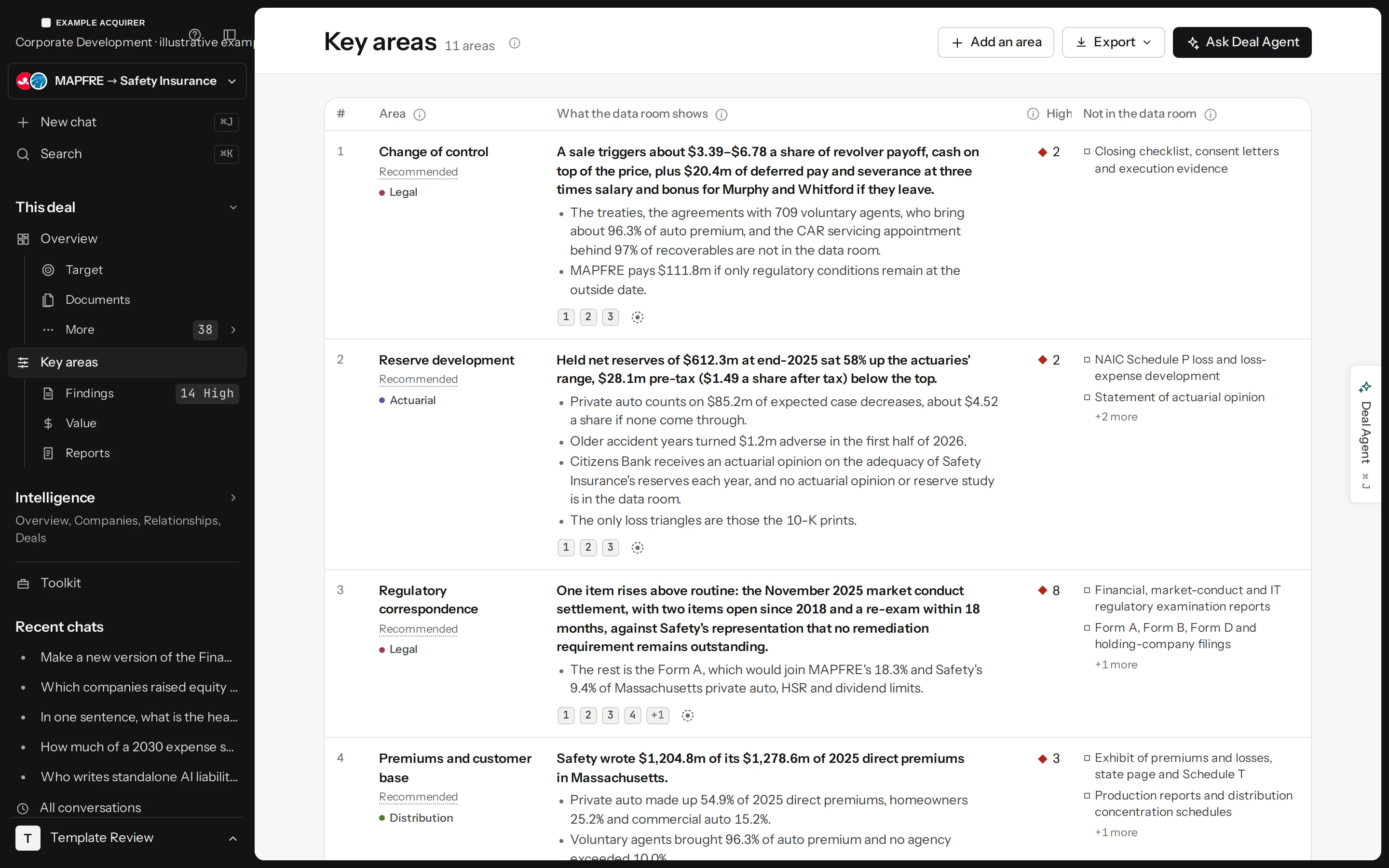
Key areas, read from the data room.
DealDen reads the data room and shows what each key area holds and lacks.
Questions about due diligence checklists
What is an M&A due diligence checklist?
It is the list of documents a buyer reviews before signing, grouped by the team that reviews each one.
What are the five core parts of due diligence?
Most deal teams start with financial, legal, tax, commercial and HR due diligence. IT, IP, property, insurance and regulatory reviews follow as the target requires.
What are the four P's of due diligence?
In fund manager due diligence, the four P's are people, philosophy, process and performance. M&A deal teams usually work through areas like the ones on this checklist.
What are red flags in due diligence?
Common red flags are customer concentration, unsupported EBITDA adjustments, change-of-control clauses and missing documents. Open claims and key people likely to leave are others.
Who prepares the due diligence checklist?
The buyer's deal lead builds it with each team and its advisers, and the seller answers it through the data room.
How is a checklist different from a request list?
The checklist is the buyer's own list of what to review. The request list goes to the seller to fill the gaps.
Can I use this checklist in Excel?
Yes. The download is a CSV file that opens in Excel, with columns for red flag, status, owner, date received and notes.